
Overview
CJC-1295 is a synthetic, tetra-substituted analog of Growth Hormone-Releasing Hormone (GHRH). It was designed to address the primary limitation of endogenous GHRH: its extremely short half-life (measured in minutes). By modifying the amino acid sequence, researchers created a stable peptide capable of stimulating the pituitary gland to release endogenous growth hormone (GH) over a more prolonged period. Additionally, cjc 1295 has gained attention for its potential benefits in enhancing muscle growth and recovery.
Mechanism of Action
The integration of cjc 1295 into training programmes has led to optimised recovery and muscle development.
CJC-1295 functions as a GHRH receptor agonist.
- Receptor Binding: It binds to the GHRH receptor (GHRHR) on the somatotroph cells of the anterior pituitary gland.
- Signaling Cascade: Binding triggers the Gs-coupled protein pathway, which leads to the activation of adenylate cyclase and the accumulation of cyclic AMP (cAMP). This initiates the synthesis and pulsatile release of GH.
- Feedback Loop: Because cjc 1295 acts upstream at the pituitary level rather than providing exogenous GH directly, the body’s natural somatostatin-mediated negative feedback loop remains operational, which is theorized to preserve the natural rhythmicity of GH secretio
The mechanism by which CJC-1295 enhances GH secretion involves the stimulation of somatotroph cells in the anterior pituitary gland. These cells are responsible for producing and releasing growth hormone in response to GHRH signals. By activating these cells, CJC-1295 increases the amplitude and frequency of GH pulses, leading to higher overall GH levels.
This, in turn, triggers a cascade of beneficial effects throughout the body, ranging from:
- Increased protein synthesis
- Enhanced muscle growth
- Improved metabolic function
- Accelerated fat loss
Moreover, cjc 1295 has been extensively studied for its role in enhancing muscle mass and recovery times, making it a valuable addition to fitness regimens.
A common stack:
- CJC-1295 (100–200 mcg) + Ipamorelin (100–200 mcg)
- Injected 1–2× daily for 8–12 weeks
CJC-1295 has been shown to stimulate insulin like growth factor 1 (IGF-1).
IGF-1 plays a critical role in preventing (inhibiting) the release of the HGH through what’s called the negative feedback loop by stimulating somatostatin and inhibiting GHRH release, CJC-1295 stacks well with Ipamorelin as a dual agonists
However, HGH and IGF-1 secretion are regulated by each other, where HGH triggers IGF-1 release, and the IGF-1 inhibits HGH release in a feedback loop. Thus, they are antagonists, yet complementary to one another.
Improved Sleep Quality
Quality sleep is another significant benefit associated with CJC-1295. Growth hormone is known to play a critical role in regulating sleep patterns and promoting restorative sleep.
By enhancing GH release, CJC-1295 can improve sleep quality, leading to better recovery, mood, and cognitive function. This is especially important for athletes and individuals with demanding lifestyles, as adequate sleep is essential for optimal performance and well-being.
Improved sleep can also have a positive impact on overall health, reducing the risk of various chronic conditions and enhancing the body’s ability to repair and regenerate.
The Crucial Distinction: DAC vs. “No-DAC”
In research literature, you will encounter two distinct formulations. It is vital to label them correctly:
| Feature | CJC-1295 (with DAC) | CJC-1295 (No DAC) |
| Structure | Includes Drug Affinity Complex | Lacks DAC |
| Half-Life | ~6–8 days | ~30–60 minutes |
| Action | Long-acting, steady-state elevation | Pulsatile, mimicking natural GH spikes |
| Usage | Fewer injections (weekly) | Multiple daily injections |
Note: In the research community, “CJC-1295 No-DAC” is widely accepted as a misnomer for Mod GRF 1-29. Mod GRF 1-29 is the stabilized version of the first 29 amino acids of GHRH without the DAC linkage.
| Compound Designation | Common Name | Chemical Formula |
|---|---|---|
| CJC-1295 with DAC | Long-acting GHRH | C₁₆₅H₂₆₉N₄₇O₄₆ |
| CJC-1295 (No Dac) | Mod GRF 1-29 | C₁₅₂H₂₅₂N₄₄O₄₂ |
Research Dosage Overview
Because these two compounds have vastly different half-lives, their dosage frequencies are functionally opposites.
| Compound | Dosage Range | Frequency | Research Context |
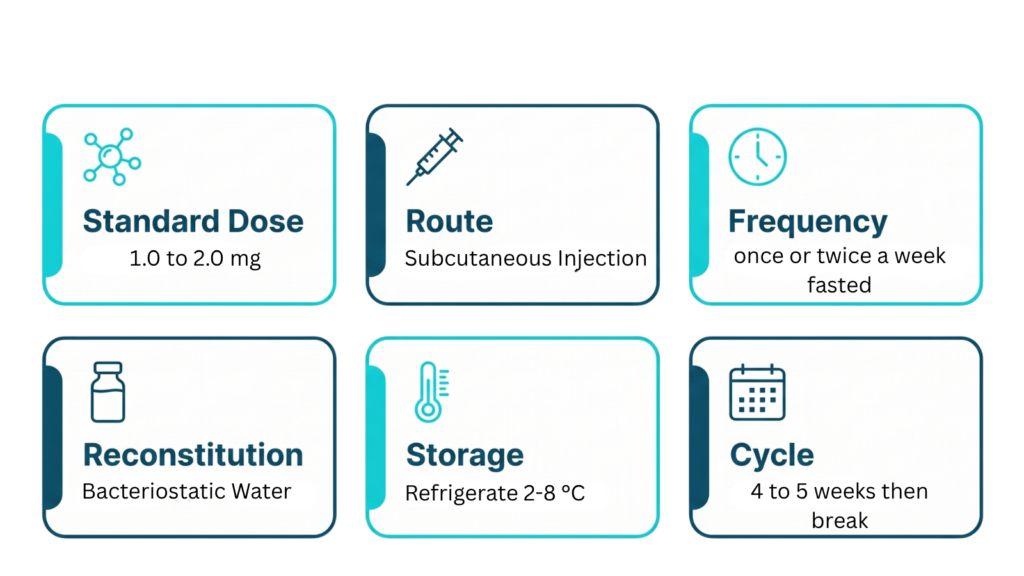
| CJC-1295 (with DAC) | 1.0 mg – 2.0 mg | Once or twice weekly | Sustained, steady-state elevation of GH. |
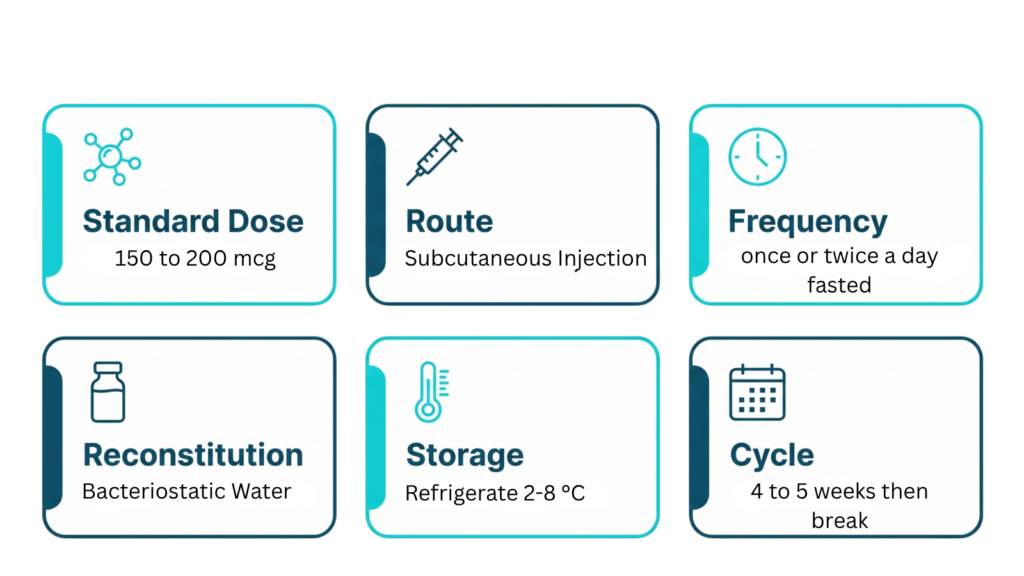
| CJC-1295 (No Dac) | 100 mcg – 200 mcg | Daily (often before bed) | Pulsatile, mimicking natural GH spikes. |
Critical Research Protocol Distinctions
1. CJC-1295 (with DAC)
- Protocol Logic: Because the Drug Affinity Complex (DAC) binds the peptide to serum albumin, it creates a “depot” effect in the bloodstream. Consequently, researchers administer this infrequently (weekly) to maintain a consistent baseline elevation of GH and IGF-1 levels.
- Administration: Typically a single subcutaneous injection of 1–2 mg per week.
- Observation: Researchers often monitor for “steady-state” effects, as the drug remains active in the system for 6–8 days.
2. CJC-1295 (No DAC)
- Protocol Logic: Lacking the DAC component, this peptide is metabolized rapidly (half-life of ~30–60 minutes). To achieve meaningful data on GH/IGF-1 stimulation, it is administered in smaller, frequent bursts.
- Administration: Typically 100–200 mcg, usually injected before sleep.
- Stacking Context: In research communities, this is frequently paired with a GHRP (like Ipamorelin) at the time of injection. The Mod GRF 1-29 primes the pituitary, while the GHRP triggers the pulsatile release, maximizing the magnitude of the GH pulse.
For maximum efficiency please feel free to use our free Peptide Calculator
CjC-1295 No Dac
CjC-1295 With Dac (Drug Affinity Complex)
How to Reconstitute Peptides Step by Step
- Clean the rubber stopper of your peptide vial with an alcohol swab and let it dry.
- Using a syringe, draw the calculated amount of bacteriostatic water.
- Insert the needle through the stopper and inject the water slowly down the inside wall of the vial. Do not aim directly at the powder.
- Gently swirl the vial until the powder dissolves completely. Never shake it, as this can degrade the peptide.
- Store the reconstituted vial in your refrigerator (2-8 °C). Use within 3 to 4 weeks.
Frequently Asked Questions
Q: What is the main difference between DAC and No-DAC?
A: DAC (Drug Affinity Complex) extends the half-life to 6-8 days for steady-state elevation. Mod GRF 1-29 (No-DAC) has a 30-60 minute half-life, intended to mimic natural pulsatile hormone release.
Q: Why stack CJC-1295 with a GHRP?
A: The stack is studied for synergy: Mod GRF 1-29 increases the pool of available GH-secreting cells, while the GHRP (e.g., Ipamorelin) triggers the release of those cells.
Q: Does it provide exogenous Growth Hormone?
A: No. It is a secretagogue that signals the pituitary gland to release endogenous growth hormone.
Q: What are the storage requirements?
A: Store lyophilized powder at -20°C. Keep reconstituted solutions in a refrigerator (2°C–8°C) and protect from light.
Q: Is this approved for human use?
A: No. These are investigational research chemicals for laboratory use only.
Sources
| Compound | PubMed Research | PubChem Data |
|---|---|---|
| CJC-1295 (DAC) | View Studies | View Data |
| CJC-1295 (No Dac) | View Studies | View Data |
Our Recommended UK Supplier
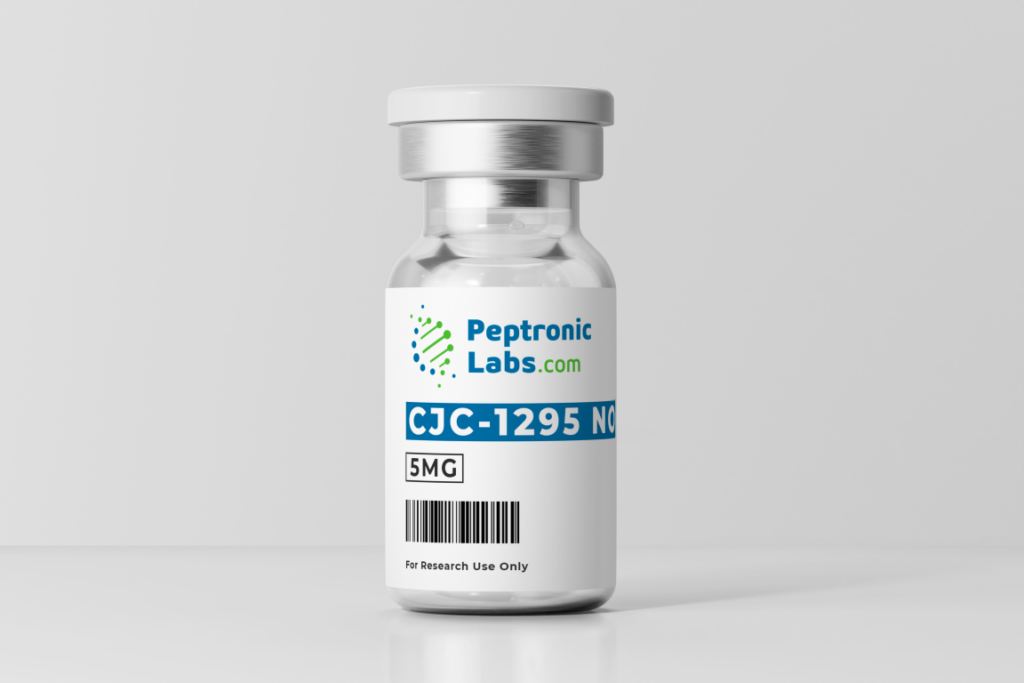
CJC-195 no dac is available from Peptronic Labs UK-based, ≥99.0% purity verified by HPLC, Royal Mail Tracked 24. View CJC-1295 No Dac