
MOTS-c is a 16-amino-acid peptide that is unique among most signaling peptides because it is encoded within the mitochondrial genome (specifically the 12S rRNA gene) rather than the nuclear DNA. First identified in 2015, it belongs to a class of molecules known as Mitochondrial-Derived Peptides (MDPs).
It is often described in research literature as an “exercise mimetic” because its levels increase in skeletal muscle during physical activity, and it appears to play a critical role in metabolic homeostasis.
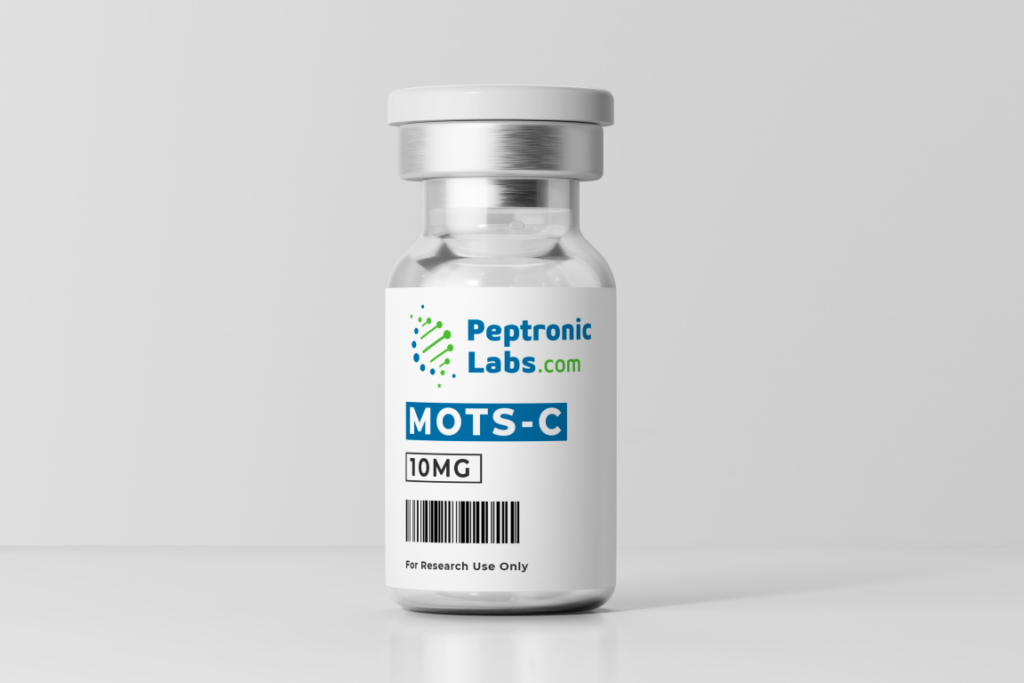
Technical Data: MOTS-c
| Property | Details |
| Name | MOTS-c (Mitochondrial Open Reading Frame of the 12S rRNA-c) |
| Amino Acid Sequence | M-R-W-Q-E-M-G-Y-I-F-Y-P-R-K-L-R |
| Chemical Formula | C101H152N28O22S2 |
| Molecular Weight | ~2174.6 g/mol |
| CAS Number | 1627580-64-6 |
Mechanism of Action
Research into mots cfocuses on its role as a “mitokine”—a signaling molecule that communicates the metabolic state of mitochondria to the nucleus and other tissues. All the products found in these detailed research notes can be found at Peptronic labs
- AMPK Activation: A primary mechanism observed in preclinical studies is the activation of the AMPK (AMP-activated protein kinase) pathway. This pathway is a master regulator of cellular energy homeostasis, influencing how the body processes glucose and fatty acids.
- Metabolic Homeostasis: Studies in mouse models suggest that MOTS-c improves insulin sensitivity and glucose uptake in skeletal muscle. By inhibiting the folate-cycle pathway, it triggers cellular responses that mimic the effects of caloric restriction or physical training.
- Gene Regulation: Upon cellular stress, motsc peptide benefits dosage has been observed to translocate from the mitochondria to the cell nucleus, where it can modulate the expression of genes related to antioxidant responses and metabolic adaptation.
Clinical and Research Status
When documenting MOTS-c, it is critical to distinguish between its biological potential in research and its current status in human application:
- Preclinical Focus: The vast majority of existing data on MOTS-c is derived from in vitro (cell culture) and in vivo (mouse/rat) models. While these studies show promising effects on insulin resistance, weight management, and physical performance, they do not automatically translate to human outcomes.
- Lack of Human Efficacy Trials: As of 2026, there are no completed, published, large-scale human efficacy clinical trials that define the safety or effective therapeutic dosage for MOTS-c in humans.
- Not FDA Approved: MOTS-c is not approved by the FDA or any other regulatory body for the treatment of any medical condition.
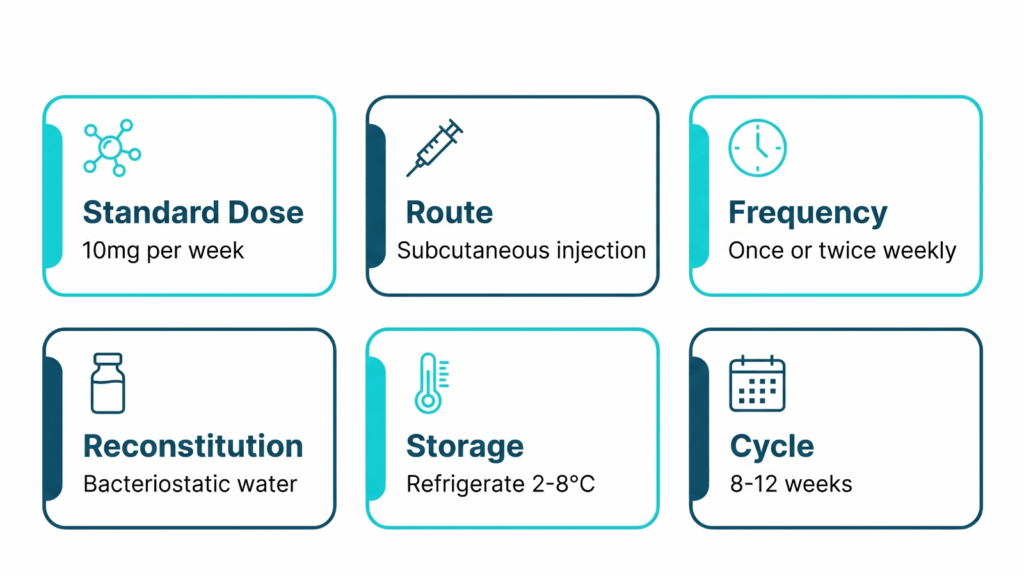
The standard MOTS-c dosage is 5 to 10 mg per week via subcutaneous injection, administered once or twice weekly, for cycles of 8 to 12 weeks. Beginners should start at 5 mg once per week and assess tolerance for two weeks before increasing.
MOTS-c (Mitochondrial ORF of the 12S rRNA Type-c) is a 16-amino-acid mitochondrial-derived peptide discovered in 2015 at USC. It activates AMPK, the same metabolic master switch triggered by exercise, earning it the label “exercise mimetic.” Search interest has surged over 800% year-over-year as researchers and biohackers explore its metabolic, body composition, and anti-aging applications.
This guide covers exact dosage protocols, reconstitution math, injection timing
MOTS-c is not FDA-approved. No completed human clinical trials exist for native MOTS-c. Consult a healthcare provider before acting on any information.
Beginner Protocol (5 mg/week)
Dose: 5 mg subcutaneously, once per week. Duration: 8 to 12 weeks. This is the starting point for first-time users.
Inject the full 5 mg in a single session. Run this protocol for at least two weeks to gauge tolerance before considering an increase. Most users settle here and report meaningful results by week four.
The beginner dose is sufficient for metabolic improvement and body composition changes. More is not always better with MOTS-c. Research on the MOTS-c analog CB4211 used 25 mg per day (a much higher dose), but native MOTS-c protocols trend lower.
Performance and Body Recomposition Protocol (10 mg/week)
Dose: 10 mg per week, split into two 5 mg injections (e.g., Monday and Thursday). Duration: 8 to 12 weeks.
This protocol targets athletes and body recomposition goals. Splitting the dose maintains more consistent AMPK activation across the week. Inject 30 to 60 minutes before exercise when possible for synergy with training-induced AMPK signaling.
Anti-Aging and Metabolic Maintenance Protocol
Dose: 5 mg once weekly. Duration: 8 to 12 weeks, repeated 2 to 3 times per year.
This is the conservative approach for general metabolic health and longevity. Once-weekly dosing provides baseline AMPK activation and mitochondrial support without chronic pathway stimulation. Cycle on and off to avoid AMPK pathway tolerance.
Pairs well with Epitalon for a multi-pathway anti-aging approach. MOTS-c addresses mitochondrial decline; Epitalon targets telomere maintenance. Two distinct hallmarks of aging, covered by two peptides.
MOTS-c Dosage for Weight Loss
The same protocols apply. Performance protocol (10 mg/week) produces faster body composition changes. The beginner protocol (5 mg/week) works for users combining MOTS-c with structured diet and training.
MOTS-c promotes fat oxidation through AMPK-mediated lipolysis and targets visceral fat specifically. It preserves lean muscle mass during caloric restriction, a meaningful advantage over GLP-1 agonists like semaglutide.
A Reddit user documented dropping from 18% to 15% body fat in 15 days on MOTS-c. Typical results are more gradual. Expect visible body composition shifts at the 6 to 8 week mark.
MOTS-c Dosage for Women
Women use the same dosage ranges as men. No sex-specific dose adjustments are established in the research.
Start with the beginner protocol (5 mg/week) and assess for two weeks. Women report similar results timelines and side effect profiles as men. The 10 mg/week performance protocol is appropriate for women pursuing body recomposition or athletic performance goals.
How Do You Reconstitute MOTS-c?
MOTS-c ships as a lyophilized (freeze-dried) powder in vials, typically 10 mg per vial. Reconstitution with bacteriostatic water is required before injection.
Reconstitution Step-by-Step
Standard approach: add 2 mL of bacteriostatic water to a 10 mg vial. This produces a concentration of 5 mg/mL.
- Bring both the vial and bacteriostatic water to room temperature.
- Wipe the rubber stopper on the vial and the BAC water vial with an alcohol swab.
- Draw 2 mL of bacteriostatic water with an insulin syringe.
- Insert the needle into the MOTS-c vial at an angle and let the water trickle slowly down the glass wall. Do not squirt directly onto the powder.
- Do not shake. Let the water dissolve the powder naturally, or swirl the vial gently.
- Once fully dissolved, the solution should be clear.
For finer dose control, add 3 mL instead of 2 mL, producing a 3.33 mg/mL concentration. Use the Peptide Reconstitution Calculator to compute exact volumes for any vial size.
For maximum efficiency please feel free to use our free Peptide Calculator
Frequently Asked Questions: MOTS-c
Q: What is the primary focus of MOTS-c research?
A: MOTS-c is primarily studied for its role as a “metabolic regulator.” Research focuses on its ability to mimic the effects of exercise by activating the AMPK pathway—a key cellular energy sensor. It is investigated for its potential to improve insulin sensitivity, enhance glucose metabolism, and mitigate age-related metabolic decline.
Q: Why is it often called an “exercise mimetic”?
A: In preclinical models, MOTS-c administration has been shown to shift metabolic profiles in a manner similar to physical activity. Researchers study this to understand how it helps cells prioritize energy utilization and fatty acid oxidation, potentially offering insight into therapies for metabolic syndrome and obesity.
Q: How does MOTS-c influence cellular health?
A: Beyond metabolism, MOTS-c is studied for its role in the “mitochondrial stress response.” It is thought to preserve mitochondrial function during periods of metabolic stress, which is a focal point in studies regarding longevity and the prevention of chronic degenerative conditions.
Q: What are the standard storage requirements?
A: MOTS-c follows standard peptide storage protocols:
Sources
| Resource | Description | Link |
|---|---|---|
| PubMed | Peer-reviewed literature on mitochondrial-derived peptides. | View Studies |
| PubChem | Molecular structure and chemical database. | View Data |
| ClinicalTrials.gov | Ongoing and past clinical investigations. | View Trials |
How to Store MOTS-c
Lyophilized (unreconstituted): store at minus 20°C in a freezer. Stable for months.
Reconstituted: refrigerate at 2 to 8°C. Use within 14 to 30 days. Do not freeze reconstituted solution. Avoid repeated freeze-thaw cycles.
MOTS-c is available from Peptronic Labs UK-based, ≥99.0% purity verified by HPLC, Royal Mail Tracked 24. View MOTS-c