
Overview
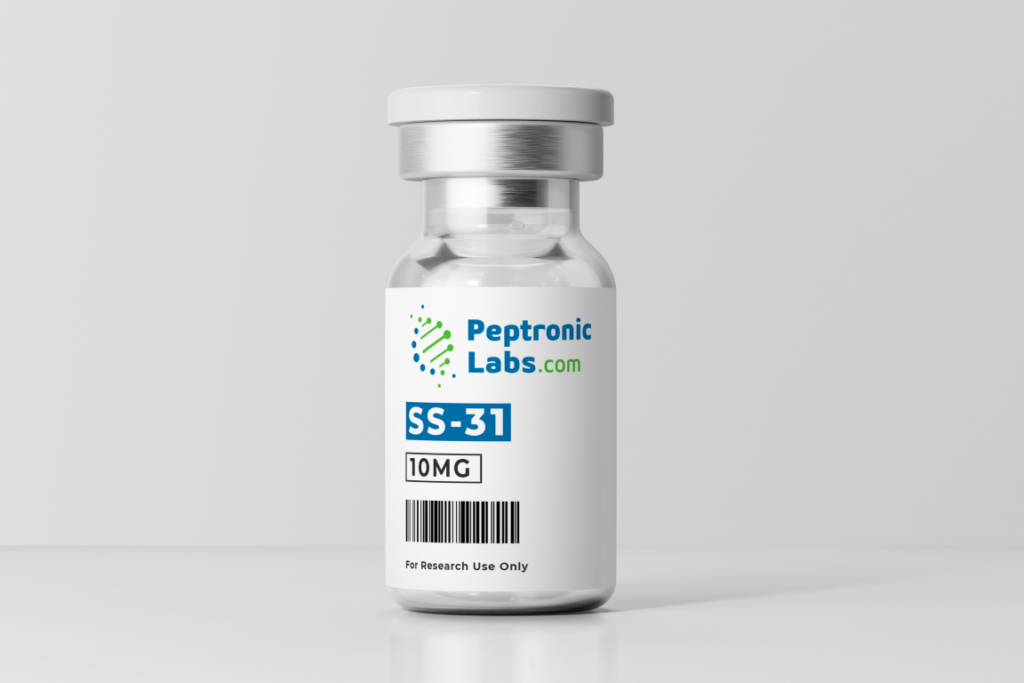
SS-31, often referred to as Elamipretide in clinical literature, is a cell-permeable, mitochondria-targeting tetrapeptide. Unlike systemic antioxidants that merely scavenge reactive oxygen species (ROS), SS-31 is studied for its ability to correct mitochondrial dysfunction at the source by stabilising the inner mitochondrial membrane.
Mechanism of Action
- Cardiolipin Stabilization: The hallmark of ss 31 is its unique affinity for cardiolipin, a phospholipid found specifically in the inner mitochondrial membrane. Cardiolipin is essential for the structure of the cristae and the efficiency of the electron transport chain.
- ROS Reduction: By stabilizing the interaction between cardiolipin and cytochrome c, SS-31 prevents the peroxidase activity of cytochrome c, which is a major driver of oxidative stress within the mitochondria.
- Bioenergetic Support: By optimizing the electron transport chain, SS-31 is researched for its ability to maintain ATP production levels even during periods of mitochondrial stress or damage.
Key Research Focus
- Mitochondrial Bioenergetics: Investigating its role in restoring energy production in aging, diseased, or damaged cells.
- Cardiac & Renal Health: Studies have heavily focused on its potential in models of heart failure and ischemia-reperfusion injury.
- Musculoskeletal Recovery: Researching the mitigation of exercise-induced mitochondrial fatigue and muscle atrophy and quality of life.
Technical Specification Table
| Compound Specifications: SS-31 | |
|---|---|
| Classification | Mitochondria-targeting peptide |
| Mechanism | Cardiolipin stabilization, ROS inhibition |
| Chemical Formula | $C_{32}H_{49}N_{9}O_{5}$ |
| Molecular Weight | 639.8 g/mol |
| Primary Target | Mitochondrial Inner Membrane |
| Administration | Subcutaneous/Intravenous (Research) |
What SS-31 Is (And Why Cardiolipin Matters)
SS-31 (elamipretide) is a mitochondria-targeted peptide that binds to cardiolipin, a fat-like molecule that sits in the inner mitochondrial membrane. Cardiolipin is basically “structural scaffolding” for the electron transport chain. When cardiolipin becomes oxidised or damaged, mitochondria lose their shape and efficiency, and ATP output falls.
A simple analogy: cardiolipin is like the elastic in an old jumper. After hundreds of washes, it gets stretched, warped, and doesn’t hold form anymore. Same story in mitochondria — oxidative stress “warps” cardiolipin, and energy production becomes sloppy, inefficient, and inflammatory.
Elamipretide’s key claim to fame is that it stabilizes cardiolipin and mitochondrial structure, improving electron transport chain efficiency and reducing runaway oxidative stress. MDPI+1
Benefits of SS-31 (Elamipretide)
The clinical and preclinical research conducted on SS-31 has demonstrated its ability to address multiple facets of cellular health and function. Below, we examine some of the specific health benefits icluding respiration and h2o2production associated with SS-31.
1. Mitochondrial Protection and Enhanced Cellular Energy
As a mitochondrial-targeted peptide, SS-31 offers direct protection for mitochondrial function, reducing oxidative stress and enhancing cellular energy production. By stabilising mitochondrial function, SS-31 significantly increases the production of ATP, providing cells with essential energy. This has shown benefits in patients with conditions marked by mitochondrial degradation, including age-related cellular dysfunction and diseases like myopathies [1].
SS-31 has shown promise in improving cardiac function by stabilising mitochondrial activity in heart cells. Mitochondrial dysfunction is a significant factor in heart disease, with mitochondrial decay leading to inadequate ATP production, oxidative stress, and ultimately, cell death. By safeguarding cardiolipin and enhancing mitochondrial resilience, SS-31 aids in maintaining cardiovascular health and reducing the likelihood of heart conditions [2].
SS-31 has shown promise in improving cardiac function by stabilizing mitochondrial activity in heart cells. Mitochondrial dysfunction is a significant factor in heart disease, with mitochondrial decay leading to inadequate ATP production, oxidative stress, and ultimately, cell death. By safeguarding cardiolipin and enhancing mitochondrial resilience, ss 31 aids in maintaining cardiovascular health and reducing the likelihood of heart conditions [2].
3. Potential Neuroprotective Effects
Neurodegenerative diseases, such as Alzheimer’s and Parkinson’s, are often linked to mitochondrial decline and oxidative damage in brain cells. SS-31’s neuroprotective properties offer potential benefits in these conditions by protecting neuronal mitochondria from oxidative stress, supporting cell viability, and enhancing energy supply. Studies have demonstrated SS-31’s capacity to enhance cognitive functions and slow the progression of neurodegeneration by stabilising mitochondrial health in neuronal cells [3].
Routes of Administration for SS-31 (Elamipretide)
SS-31 is commonly administered via subcutaneous injection, providing a direct route to the bloodstream and optimizing its bioavailability. This method ensures that the peptide reaches target cells efficiently, offering faster and more pronounced therapeutic effects. Due to its rapid absorption, subcutaneous administration has become the preferred route for clinical use.
In some cases, intravenous (IV) administration may be considered, particularly for acute settings or when a higher concentration is required. Both methods are designed to maximize SS-31’s access to mitochondrial cells across various organs, allowing for comprehensive cellular support.
Research Note: SS-31 (Elamipretide) Protocols
Clinical Context: In human clinical research trials, Elamipretide has been studied using subcutaneous injection routes. Dosage is highly specific to the medical indication being investigated (e.g., mitochondrial myopathies).
Preclinical Context: Laboratory models utilize weight-based dosing (mg/kg). Stability is a key variable; researchers often account for the peptide’s susceptibility to oxidation by using fresh, reconstituted solutions stored at 2°C–8°C.
Important Considerations
- Individual Variability: Dosages in literature are specific to the study design and are not applicable to the general public.
- Administration: Always adhere to sterile technique and use a peptide calculator to ensure accurate concentrations based on your study’s mg/kg requirements.
- Safety: SS-31 is an investigational compound. Research must be performed in accordance with institutional guidelines, Is SS-31 FDA approved?.
Typical SS-31 Dosage Ranges — Clinical Context
SS-31 dosing in compounding-based wellness medicine draws from both the clinical trial data generated in Elamipretide research and from evolving physician experience in longevity medicine. The most commonly referenced ranges in physician-supervised protocols:
• Low/introductory range: 2–5 mg per injection
• Standard clinical range: 5–10 mg per injection
• Higher therapeutic range: 10–20 mg (physician-directed for specific goals)
These are ranges observed in clinical use — not prescriptive recommendations. Your physician assesses your health history, goals, and response to determine what is appropriate for you specifically. The right dose for a 40-year-old biohacker with good baseline health is different from the right dose for a 65-year-old with metabolic syndrome and pronounced fatigue.
SS-31 Dosage by Goal
| Primary Goal | Typical Dose Range | Frequency | Notes |
| General energy & fatigue | 5 mg | 3–5x/week | Introductory — assess response first |
| Athletic recovery & performance | 5–10 mg | 5–7x/week | Daily or near-daily for training recovery support |
| Longevity & healthy aging | 5–10 mg | 3–5x/week | Ongoing maintenance protocol |
| Advanced cellular health | 10–20 mg | Physician-directed | Under close monitoring; not self-prescribed |
| Mitochondrial support (stacked) | 5 mg | 3–5x/week | Reduced dose when combined with NAD+ or MOTS-C |
For maximum efficiency please feel free to use our free Peptide Calculator
How to Reconstitute Peptides Step by Step
- Clean the rubber stopper of your peptide vial with an alcohol swab and let it dry.
- Using a syringe, draw the calculated amount of bacteriostatic water.
- Insert the needle through the stopper and inject the water slowly down the inside wall of the vial. Do not aim directly at the powder.
- Gently swirl the vial until the powder dissolves completely. Never shake it, as this can degrade the peptide.
- Store the reconstituted vial in your refrigerator (2-8 °C). Use within 3 to 4 weeks.
Frequently Asked Questions
How does SS-31 differ from other mitochondrial therapies?
SS-31 is unique due to its selective targeting of cardiolipin in the mitochondrial membrane. This targeted approach allows SS-31 to directly stabilize mitochondrial function and prevent oxidative damage, setting it apart from other antioxidants or mitochondrial-supportive supplements.
What is the recommended dosage for SS-31?
Dosage varies based on individual needs and the specific health condition being addressed. Patients are advised to consult with their healthcare provider to determine the optimal dosage for their needs.
Can SS-31 help with age-related fatigue?
Yes, SS-31 may alleviate age-related fatigue by enhancing mitochondrial function and increasing cellular ATP production, which can improve energy levels and physical endurance.
How quickly does SS-31 start to work?
Many patients report improvements within a few days to weeks. However, full benefits, especially in cases of chronic mitochondrial dysfunction, may require consistent use over several weeks or months.
Is SS-31 safe for long-term use?
Research suggests that SS-31 is well-tolerated in long-term applications, with minimal side effects. Ongoing monitoring and consultation with a healthcare provider are recommended for sustained usage.
Can SS-31 improve exercise performance?
Yes, SS-31 has shown benefits in enhancing muscular endurance and reducing exercise intolerance in patients with mitochondrial myopathies, suggesting it may support better exercise performance.
Sources
| Resource | Description | Link |
|---|---|---|
| PubMed | Research on mitochondrial stabilization and SS-31. | View Studies |
| PubChem | Molecular data and chemical properties (CID 11764719). | View Data |
| ClinicalTrials.gov | Clinical research records for Elamipretide. | View Trials |
Our Recommended UK Supplier
SS-31 is available from Peptronic Labs UK-based, ≥99.0% purity verified by HPLC, Royal Mail Tracked 24 View SS-31