
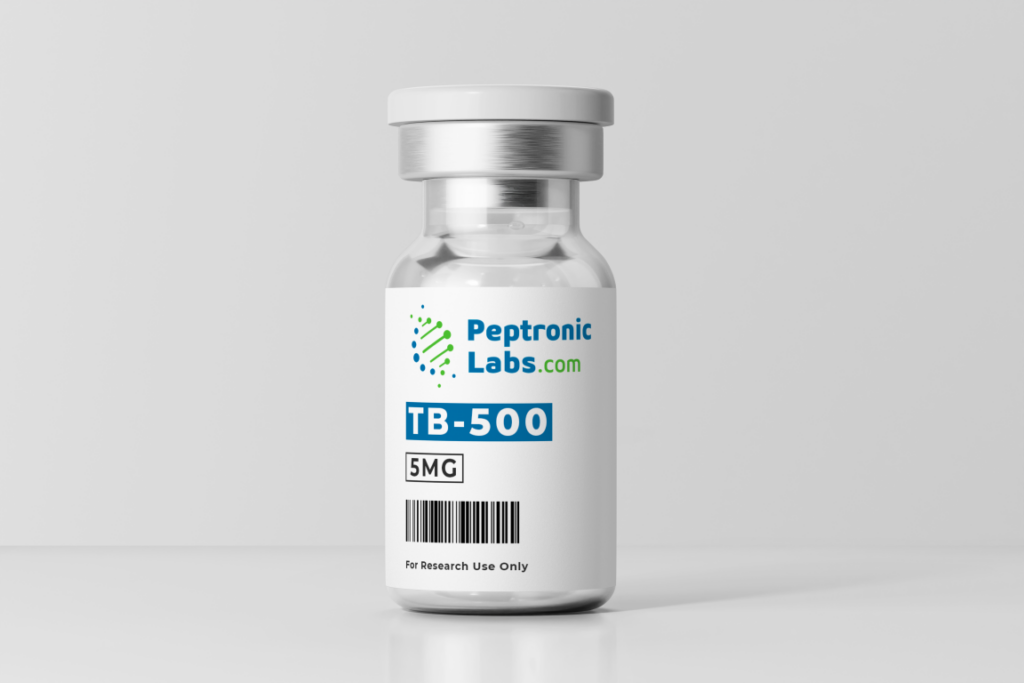
TB-500 is a synthetic version of the naturally occurring peptide Thymosin Beta-4. In research settings, it is primarily studied for its significant regenerative, anti-inflammatory, and wound-healing properties. Unlike many other peptides that act as growth hormone secretagogues, TB-500 functions primarily by promoting the upregulation of actin, a protein vital for cell structure and motility.
Potential Areas of Research
Studies utilizing TB-500 often focus on the following:
- Tissue Repair: Investigations into its ability to accelerate the repair of tendons, ligaments, and muscle tissue.
- Anti-Inflammatory Properties: Research into its capacity to reduce inflammation in joint injuries and connective tissues.
- Angiogenesis: Studies on its potential to promote the growth of new blood vessels, which supports the healing process.
- Cell Migration: Exploration of its role in promoting cell migration and differentiation, which are critical stages in the healing of skin and internal tissues.
Actin-Sequestering Properties: The primary mechanism of Thymosin Beta-4 (the basis for TB-500) is its role as a G-actin sequestering protein. By binding to G-actin, TB-500 regulates the polymerization of actin filaments, which is essential for cell motility and structural maintenance. This actin-regulation capability allows for:
- Cell Migration: Accelerating the movement of cells to injury sites, which is vital for effective tissue repair.
- Differentiation: Assisting in the recruitment of stem cells to the site of damage, promoting the differentiation into the required tissue type (e.g., fibroblast to myofibroblast for healing).
- Angiogenic Potential: Promoting the formation of new blood vessels (angiogenesis), which increases nutrient and oxygen delivery to compromised tissues.
2. Expanded Research Applications
Use these bullet points to outline where TB-500 is currently being investigated.
- Tendon and Ligament Repair: Research focuses on its ability to stimulate tenocytes (tendon cells) and increase the deposition of collagen, potentially reducing scar tissue formation in chronic injuries.
- Cardiac Recovery: Studies have explored the peptide’s cardioprotective effects, specifically investigating its ability to improve survival and function of cardiac cells following ischemic injury.
- Neurological Research: Recent research into tb 500 includes its role in neurogenesis and its potential to protect neurons from oxidative stress.
- Anti-Inflammatory Modulation: Evidence suggests it modulates proinflammatory cytokines (such as TNF-alpha), which is a key area of interest for managing chronic inflammatory states in connective tissues.
3. Safety & Research Caveats (Essential for Professionalism)
Including this adds credibility to your research page.
Important Research Considerations: benefits a summary risks safety TB-500 is a potent bioactive agent. Because it functions by modulating cell motility and actin polymerization, researchers must be aware of the following:
- Cell Proliferation: Due to its role in cell migration and angiogenesis, researchers investigate its potential effects on existing cell populations.
- Systemic Interaction: TB-500 is systemic, meaning it travels through the body via the circulatory system, which researchers must account for when designing targeted injury-recovery studies.
- Source Purity: As with all research peptides, the source purity and the absence of bacterial endotoxins are critical variables that dictate the reproducibility of research outcomes.
Research Dosage Guidelines
Disclaimer: The following information is for research and educational purposes only. TB-500 is a research chemical and not for human consumption or medical use.
Dosage in research literature varies depending on the specific model and objective. Researchers often observe the following patterns:
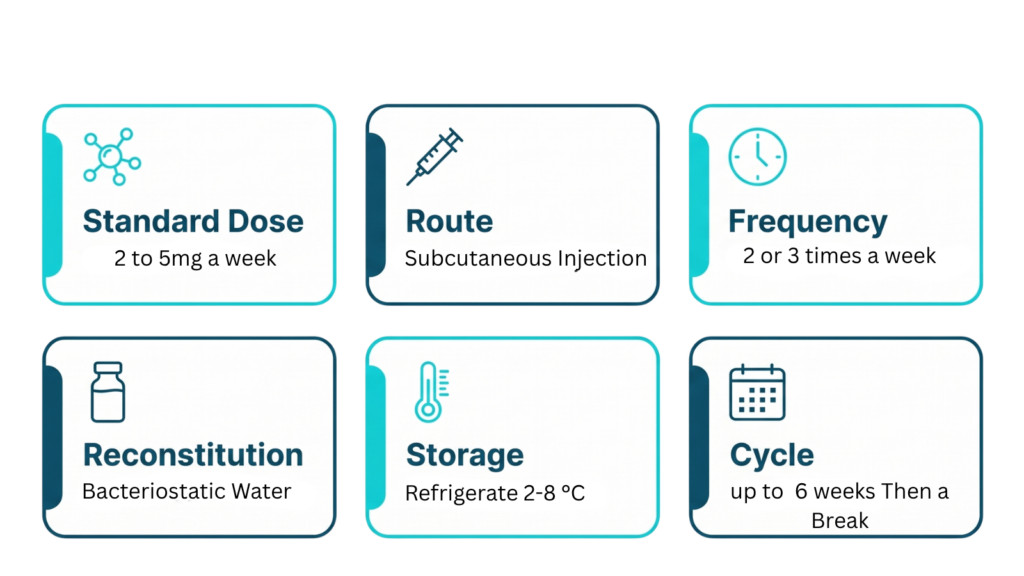
- Standard Weekly Range: Typically ranges from 2 mg to 5 mg per week.
- Loading Phase: Some protocols initiate with a loading phase of 4–6 weeks to achieve saturation, administering the dose twice weekly.
- Maintenance Phase: After the initial phase, researchers often adjust to a lower maintenance dose (e.g., 2 mg every 2 to 4 weeks) depending on the desired outcomes of the specific study.
- Administration: Typically administered via subcutaneous or intramuscular injection.
For maximum efficiency please feel free to use our free Peptide Calculator
Storage Instructions
- Lyophilized Powder: Before reconstitution, vials should be stored in a cool, dry place away from direct light. For long-term storage, is recommended.
- Reconstituted: Once mixed with bacteriostatic water, it should be kept refrigerated at (2-8 °C) and used within a short timeframe to maintain potency.
Chemical Data Table
| Technical Specifications: TB-500 (Thymosin Beta-4) | |
|---|---|
| Full Name | Thymosin Beta-4 |
| CAS Number | 77591-33-4 |
| Molecular Formula | C212H350N56O78S |
| Molecular Weight | ~4963.5 g/mol |
| Amino Acid Sequence | Ac-Ser-Asp-Lys-Pro-Asp-Met-Ala-Glu-Ile-Glu-Lys-Phe-Asp-Lys-Ser-Lys-Leu-Lys-Lys-Thr-Glu-Thr-Gln-Glu-Lys-Asn-Pro-Leu-Pro-Ser-Lys-Glu-Thr-Ile-Glu-Gln-Glu-Lys-Gln-Ala-Gly-Glu-Ser |
| Mechanism | Actin-sequestering / G-actin binding protein |
| Stability | Lyophilized stable at -20°C; Reconstituted stable at 2-8°C |
| Property | Technical Description |
|---|---|
| Half-Life | Approximately 7–10 days in systemic circulation |
| Solubility | Soluble in water and physiological saline |
| Optimal Storage | Lyophilized: -20°C; Reconstituted: 2°C to 8°C (up to 14 days) |
How to Reconstitute Peptides Step by Step
- 1.Clean the rubber stopper of your peptide vial with an alcohol swab and let it dry.
- 2.Using a syringe, draw the calculated amount of bacteriostatic water.
- 3.Insert the needle through the stopper and inject the water slowly down the inside wall of the vial. Do not aim directly at the powder.
- 4.Gently swirl the vial until the powder dissolves completely. Never shake it, as this can degrade the peptide.
- 5.Store the reconstituted vial in your refrigerator (2-8 °C). Use within 3 to 4 weeks.
Frequently Asked Questions (FAQ)
Q: Why is TB-500 used for injury research?
A: TB-500 is primarily studied for its role in cell motility. By allowing cells to migrate, it speeds up the healing process for ligaments, tendons, and muscles, and is often investigated for its potential to help repair localized damage that is otherwise slow to heal.
Q: How does TB-500 differ from BPC-157?
A: While both are studied for injury repair, their mechanisms differ. BPC-157 is a stable gastric pentadecapeptide that primarily protects the lining of the GI tract and stimulates angiogenesis locally. TB-500 is a systemic regulator of actin, making it more effective at broad tissue migration and total-body repair mechanisms. Many researchers “stack” these two for synergistic effects.
Q: What is the typical storage protocol?
A: TB-500 is sensitive to temperature. The lyophilized powder should be kept in a freezer at -20°C for long-term storage. Once reconstituted with bacteriostatic water, it must be kept in the refrigerator (2°C to 8°C). Avoid vigorous shaking of the vial, as this can degrade the long-chain amino acid structure.
Research Resources
| Source | Description | Link |
| PubMed | Clinical studies on Thymosin Beta-4 and healing. | View Studies |
| PubChem | Chemical data and molecular structure. | View Data |
Our Recommended UK Supplier
TB500 is available from Peptronic Labs UK-based, ≥99.0% purity verified by HPLC, Royal Mail Tracked 24. View TB500